Gear and Camera Guides
Mirrorless vs DSLR: Which Is Better for Beginners?


Author
Vasundhara Mukherjee
Senior Content Generalist at Photon and a hobbyist photographer who believes pictures speak louder than words, while continuing to make a living finding the right ones.
TL;DR
For most beginners: Mirrorless is the better choice.
Why mirrorless: Easier-to-learn autofocus, plus you can preview your exposure before taking the shot.
Why it matters: Seeing your exposure in real time can make a big difference while you're still learning.
Industry direction: Camera manufacturers are increasingly building for mirrorless.
When a DSLR still makes sense:
You find a great deal on the used market and want to save money.
You specifically prefer an optical viewfinder, particularly for outdoor and sports photography.
Don't forget editing: Shooting RAW unlocks more of the quality your camera can produce.
If you’re buying your first interchangeable-lens camera in 2026, mirrorless is likely to be the better long-term choice. You get exposure preview, newer autofocus systems, stronger video features, and access to camera systems receiving most current investment. A used DSLR can still be excellent value, especially if your budget is limited or you already own compatible lenses.
What Is the Difference Between Mirrorless vs. DSLR?
A DSLR (Digital Single-Lens Reflex) has a mirror inside the body. Light comes in through the lens, hits the mirror, and bounces up into an optical viewfinder so you see exactly what the lens sees, in real life, through glass. When you press the shutter, the mirror flips up out of the way, the sensor captures the image, and the mirror flips back down.
A mirrorless camera has no mirror. Light goes straight from the lens to the sensor, and the sensor sends a live digital preview to either a small screen inside the viewfinder (called an electronic viewfinder, or EVF) or to the back screen of the camera. There is no mechanical flipping. Just light, sensor, and a digital preview of what you are about to capture.
This sounds like a small mechanical detail. It is not. The presence or absence of that mirror changes nearly everything about how the camera works, how it feels to shoot with, and what it can do.
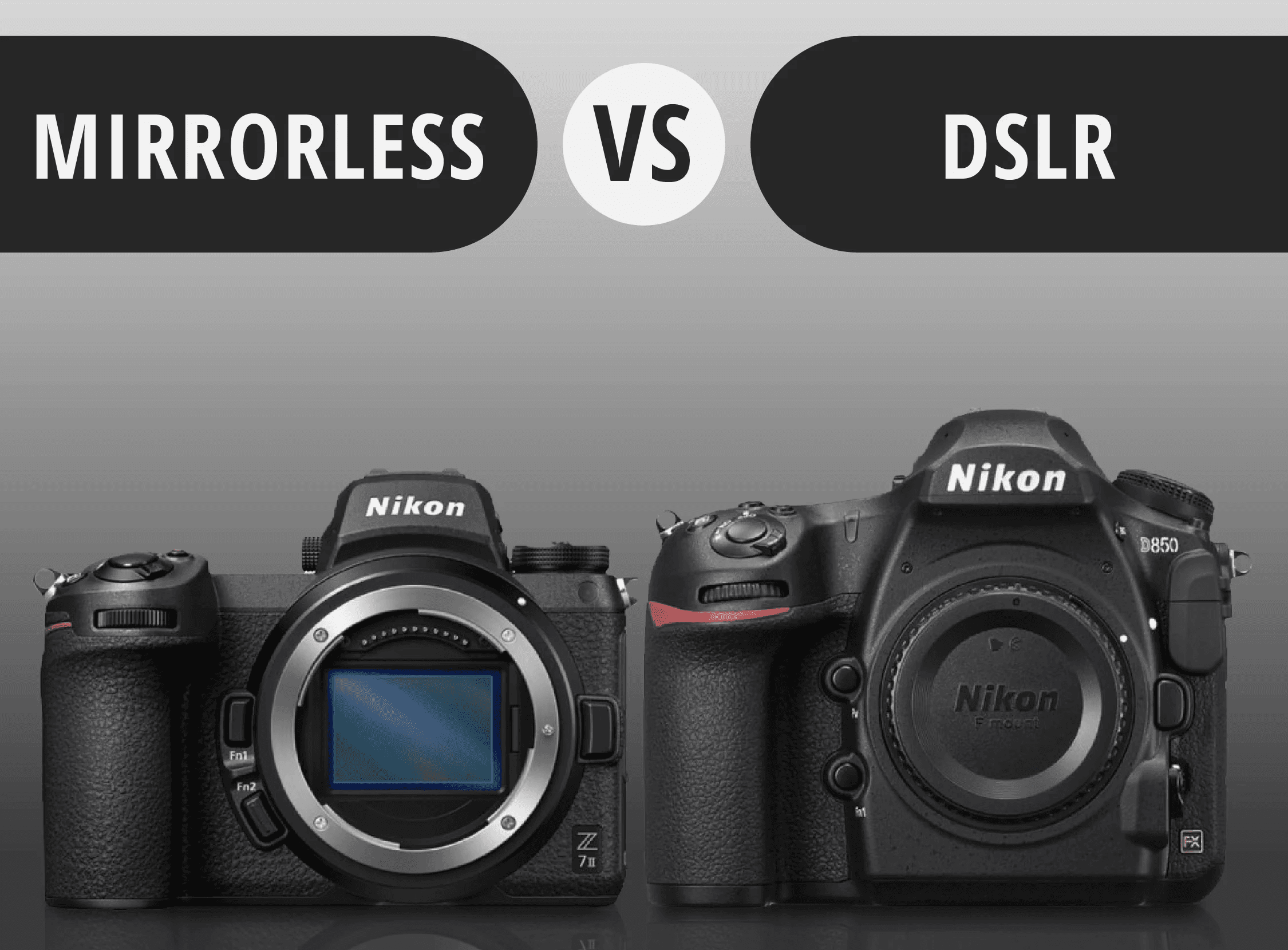
Mirrorless vs DSLR: Why is mirrorless the better choice for most beginners?
Five years ago, this debate was quite close. Today, it is not. The major camera manufacturers (Canon, Nikon, Sony, Fujifilm) have moved almost entirely to mirrorless for new releases, and the technology has caught up to or surpassed DSLRs in nearly every area beginners actually care about. Here is the honest breakdown between mirrorless vs. DSLR.
1. You see the photo before you take it
This is the single biggest reason mirrorless is better for beginners, and almost nobody explains it well. When you look through the electronic viewfinder on a mirrorless camera, you see your photo as it will actually be captured, with your exposure, white balance, and depth of field already applied. If your photo is going to be too dark, the viewfinder shows you a dark photo. If your colours are off, you see them off. You learn to expose and balance correctly because the camera shows you what is wrong in real time, before you press the shutter.
On a DSLR with an optical viewfinder, you see the scene the way your eye sees it. The exposure preview comes after you take the photo, when you check the back screen. You learn photography by trial and error, frame by frame, instead of by live feedback. Both work. One is considerably faster to learn from.
2. Autofocus is easier and smarter
Modern mirrorless cameras have autofocus systems that cover most of the frame and can recognise eyes, faces, animals, and even vehicles automatically. Point the camera at a person and the focus snaps to their eye without you doing anything. For a beginner, this is genuinely transformative. You stop missing focus on the moments that matter and start trusting the camera.
Entry-level DSLRs typically have autofocus points clustered around the centre of the frame and lack the AI-driven subject detection that mirrorless cameras now have built in. You can still get sharp photos, but you will work harder for them and miss more shots while you are learning.
3. Smaller, lighter, easier to carry
Without the mirror box, mirrorless cameras are physically smaller and lighter when it comes to DSLRs. This is important because the camera you bring with you is the camera you actually use, and a smaller body is a body you bring on more walks, more trips, more days out. Beginners who buy heavy DSLRs often end up leaving them at home. Beginners who buy mirrorless tend to shoot more.
4. Video that works better
If you ever plan to shoot any video, mirrorless wins decisively when it comes to mirrorless vs. DSLR. The autofocus during video recording is smoother and faster, the cameras have better video features built in (4K is standard, slow motion is common, microphone inputs are everywhere), and the viewfinder works during recording. Most DSLRs were not designed for video as a primary use, and it shows.
5. The whole industry is building for mirrorless
This is the longer-term reason. Canon and Nikon both stopped developing new DSLR bodies years ago. New lenses, new technology, new firmware features all happen on the mirrorless side now. If you buy a DSLR today, you are buying into a system that is no longer evolving. If you buy mirrorless, you are buying into the system the entire industry is investing in for the next decade.
Where DSLRs still make sense today
Despite all of that, there are three real situations where a DSLR is still the right call for a beginner when it comes to mirrorless vs. DSLR.
1. If you find a great deal on the used market
This is the big one. Because so many photographers have moved to mirrorless, the used DSLR market is full of excellent cameras at very low prices. You can pick up a Canon Rebel T7i, a Nikon D5600, or a Pentax K-70 for a fraction of what they cost new, paired with one or two solid lenses, for less than the body alone of an entry-level mirrorless. If your budget is tight and you want to learn the fundamentals of photography on a real interchangeable-lens camera, a used DSLR is a financially smart way in.
The trade-off is that you are buying into a system that is no longer being developed. New lenses are rare, new accessories are rare, and in two or three years you will likely upgrade to mirrorless anyway. But for $300-500 total, you can absolutely learn photography on a used DSLR and get great photos out of it.
2. If you want the optical viewfinder experience
Some photographers genuinely prefer looking through glass to looking at a screen. The optical viewfinder is clear, lag-free, never runs out of battery, and works in any light. For outdoor sports photography, fast-moving subjects in bright sun, or just the aesthetic of looking through a real viewfinder, some people will always prefer the DSLR feel. If that is you, do not let the trend talk you out of it. Buy what you want to actually shoot with.
3. If you have inherited DSLR lenses
This is a smaller case but worth mentioning. If you have access to a collection of older DSLR lenses (Canon EF, Nikon F, Pentax K-mount), buying a body that fits them directly may save you significant money compared to buying mirrorless and adapting them. Adapters exist and work well, but they add cost and bulk.
Mirrorless vs DSLR for Beginners: Side by Side
Here is the comparison across the categories beginners need to know about.
Category | Mirrorless | DSLR |
Viewfinder | Electronic, shows exposure live | Optical, shows scene through glass |
Autofocus | AI subject detection, covers most of frame | Centre-weighted, fewer AI features |
Size and weight | Smaller and lighter | Larger and heavier |
Battery life | Shorter (300-500 shots typical) | Longer (700-1200 shots typical) |
Video | Excellent, smooth autofocus | Capable but limited |
New gear available | Active development, new bodies and lenses | Legacy stock, very limited new releases |
Used market value | Holds value better | Excellent deals available |
Beginner price (body + kit lens) | $700-1000 new | $300-500 used, rare new |
Do Mirrorless Cameras Take Better Photos Than DSLRs?
This is probably the first question you'll have once you understand the mechanical difference between the two. If mirrorless cameras have newer autofocus systems, electronic viewfinders, and newer technology, does that actually mean the photos are better? Not automatically.
A mirrorless camera doesn't inherently produce better image quality than a DSLR. Both can produce excellent photographs, and the biggest factors are still the sensor, lens, light, exposure, composition, and what you do with the image afterwards.
The advantage of mirrorless is more about how easily you can get to that image.
1. Exposure preview can make a difference
An electronic viewfinder can show you a preview of how your exposure will look before you take the photograph. If the image is too dark, you can see it. If you've changed your white balance and the colors shift, you can see that too.
With a DSLR's optical viewfinder, you're looking directly at the scene rather than at a processed preview. You take the photograph, check the result on the rear screen, and then adjust.
Neither approach produces inherently better image quality. The difference is that mirrorless gives you more information before you press the shutter.
2. Autofocus can help you get more usable photos
Modern mirrorless cameras also tend to have sophisticated subject detection and tracking. Depending on the camera, autofocus can recognize faces, eyes, animals, and other subjects and follow them across the frame.
That's useful for beginners because you spend less time worrying about whether you've put the focus point in exactly the right place.
A DSLR can still produce an incredibly sharp photograph. The difference is often how much work the camera does for you while you're getting there.
3. The lens matters just as much
A camera body is only part of the equation. A great sensor paired with a basic lens won't necessarily outperform a slightly older camera paired with an excellent lens. The lens affects sharpness, focal length, low-light performance, depth of field, and how the photograph ultimately looks. That's one reason you shouldn't choose a camera based only on the body.
What about sensor size?
Sensor size matters, but you don't need to start with a full-frame camera to get excellent image quality. APS-C cameras can produce excellent photographs and are more than capable of handling travel, portraits, street photography, family photography, and plenty of professional work.
For most beginners, learning how to use the camera matters much more than moving immediately to a larger sensor.
So, should you buy a mirrorless camera or a DSLR?
The framework that works for most beginners has a couple of conditions that need to be met before you decide to purchase your first camera
1. If your budget is $700 or more
Good entry-level options include the Canon EOS R50, Sony a6400, Fujifilm X-T30 II, and Nikon Z50 II. All four give you a modern autofocus system, an electronic viewfinder, good image quality, and access to mirrorless lens systems that are still actively supported. Pick the one whose controls and menu system feel intuitive when you handle it in a store.
2. If your budget is $300-500
Buy used. A used entry-level mirrorless such as a Sony a6000-series camera can be a good way into the system, while a used DSLR can give you even more camera for the money. If you choose mirrorless, check the lens options and prices for the system before buying. If you choose DSLR, treat the lower price as the main advantage rather than expecting the system to keep expanding.
3. If your budget is under $300
Buy a used DSLR with a kit lens. You will learn photography just as well as someone with a $2000 camera, and you will lose less money when you eventually upgrade. The Canon Rebel T5 or Nikon D3300 are excellent learning cameras at this price.
4. If you specifically know you want to shoot video
Buy mirrorless. This is not close. Even at the entry level, mirrorless video is significantly better than DSLR video for autofocus, framing, and overall workflow.
Which Camera Should You Buy?
Once you've decided which camera makes sense for you, the next question is which one. Here are a few starting points based on what you actually want to photograph.
Photography type | Camera to consider | Why |
|---|---|---|
Travel photography | Canon EOS R50 | Compact, approachable and easy to carry |
Wildlife photography | Nikon Z50 II | Strong autofocus and access to Nikon's Z telephoto lenses |
Street photography | Fujifilm X-T30 II | Compact body and physical controls |
Everyday photography | Sony a6400 | Strong autofocus and a broad lens ecosystem |
Family photography | Canon EOS R50 | Straightforward autofocus and operation |
Photography + video | Sony a6400 | Strong hybrid capabilities |
Learning photography fundamentals | Fujifilm X-T30 II | Physical controls make exposure settings easier to understand |
A camera that works beautifully for one photographer may feel completely wrong in someone else's hands. That's why I'd still recommend handling your shortlist in a store before buying.
Pay attention to the things you can't really understand from a spec sheet:
Does the grip feel comfortable?
Can you find the controls without thinking?
Does the menu make sense to you?
Can you comfortably look through the viewfinder?
Does the camera feel like something you'd actually want to carry?
Don't Forget the Lens
When you're buying your first interchangeable-lens camera, you're not really buying a camera. You're buying into a camera system. The body matters, but the lenses you can put on it will have a huge impact on what you can photograph and how your photographs look.
1. Start with the kit lens
A kit lens is often the right place to start. It gives you a useful range of focal lengths without requiring you to immediately spend hundreds of dollars on additional lenses. More importantly, it gives you time to figure out what you actually enjoy photographing.
After a few months of shooting, you may discover that you constantly use the wide end of the zoom. Or perhaps you're always zoomed in. That tells you much more about which lens to buy next when you're looking for one.
2. Travel photography
For travel, versatility usually matters more than having the widest possible aperture.
A standard zoom can cover landscapes, buildings, food, people, and everyday moments without requiring you to carry several lenses.
If you're walking around a city all day, a lens that gives you useful range without adding a lot of weight can make a bigger difference than a technically superior lens that stays in your hotel room.
3. Portrait photography
Portrait photographers often benefit from a fast prime lens.
A wider aperture can help separate your subject from the background and can also be useful when you're shooting in lower light.
You don't need an expensive portrait lens to start learning, though. A relatively affordable prime can teach you a lot about composition and depth of field.
4. Wildlife photography
Wildlife is where the lens becomes especially important.
You need enough focal length to actually fill the frame with your subject. That usually means investing in a telephoto lens.
For wildlife, I'd rather see a beginner buy a slightly less expensive camera body and put more of the budget toward an appropriate telephoto lens than spend everything on the body and compromise on reach.
5. Street photography
Street photographers often value a small, lightweight setup.
A compact prime can make it easier to carry your camera everywhere and can also encourage you to work within a fixed focal length.
That limitation can actually be useful while you're learning. Instead of constantly zooming, you start thinking more carefully about where you stand and how you frame the scene.
6. Landscape photography
Landscape photographers often benefit from a wide-angle lens, particularly when they want to emphasize foreground and create a sense of scale.
But again, you don't need to buy one immediately.
Start with the lens you have. Learn what focal lengths you naturally gravitate toward, then invest when you know what you're missing.
Look at the lens ecosystem before choosing your camera
This is one of the most important things to consider when comparing mirrorless systems. First ask: "Does this system have the lenses I might want in three or five years?"
Look at the price of those lenses. Look at their size and weight. Look at whether the focal lengths you need are available.
The camera body is likely to be replaced at some point. Your lens collection can stay with you for much longer.
Editing Your Photos With Photon
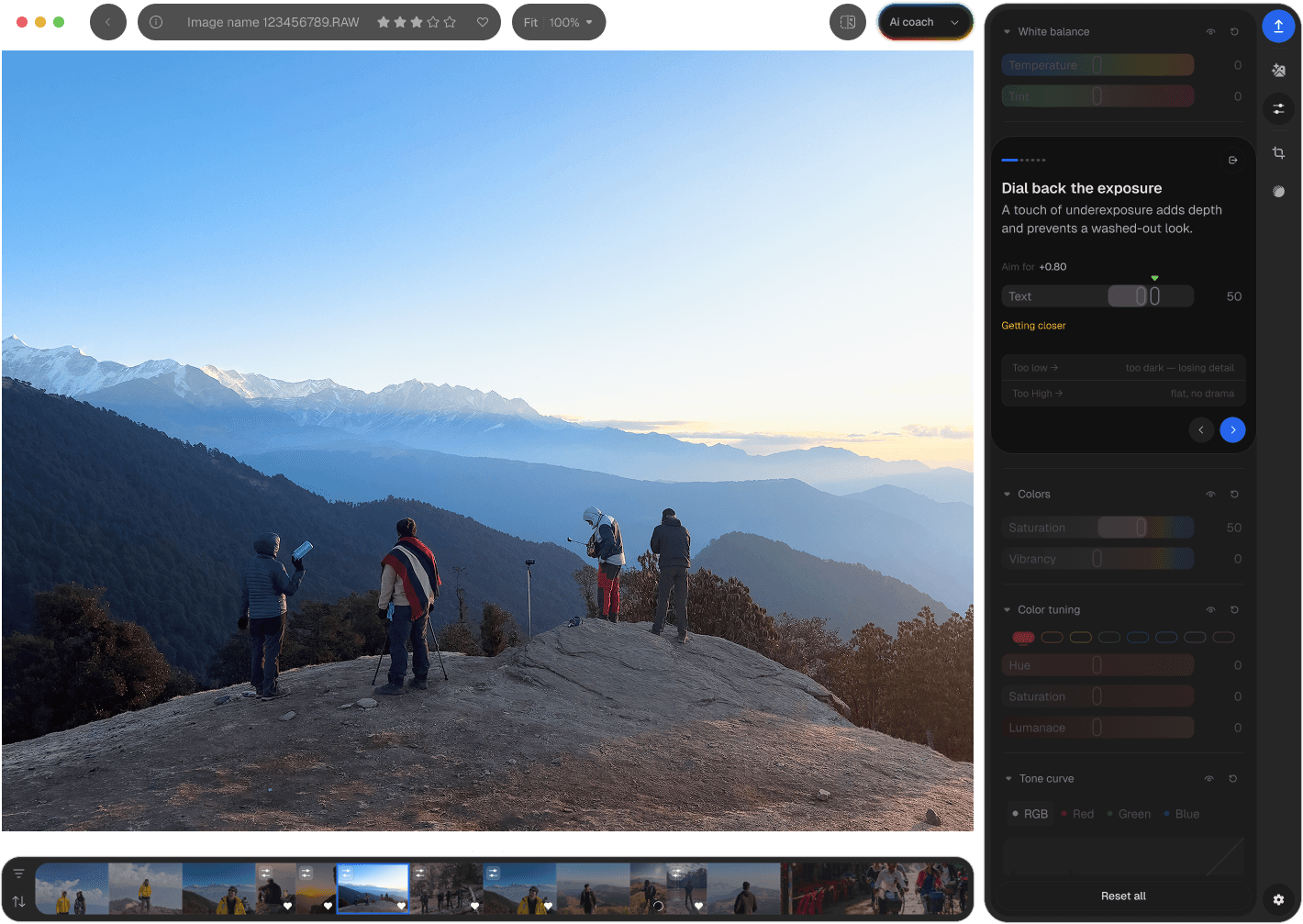
Once you buy your camera, you will quickly learn that the photos straight out of the camera are not the photos you imagined taking. The light is flatter, the colours feel off, the shadows are deeper than your eye remembers. This is not a failure of your camera. This is what RAW files look like.
RAW files are the unprocessed, unedited version of what your sensor captured. They hold dramatically more information than a JPEG, which means you can recover detail in the shadows, fix the white balance, push and pull the colours, and get the photo you actually wanted. Many photographers shoot RAW when they want maximum flexibility in post-processing.
But the catch is that RAW files need editing. And for most beginners, the editing software is where photography gets overwhelming. Lightroom is the industry standard, but it is also expensive, complicated, subscription-based, and built for working professionals. A lot of beginners buy a great camera, shoot a few hundred RAW files, open Lightroom, get lost, and quietly switch back to JPEG. Photography stalls before it ever really starts.
This is the problem we have been working on. Photon is a free RAW editor built specifically for hobbyist photographers who want their photos to look great without spending months learning professional software. It is simple by design. You drop your RAW files in, the AI Coach helps you understand what to edit and why so you learn editing on the go in the images you take.
It is free. It works with RAW files from every major camera brand, mirrorless or DSLR. And it does not require a subscription, an Adobe account, or three weeks of YouTube tutorials before you can use it.
The Bottom Line
For most beginners, mirrorless is the right choice between mirrorless vs. DSLR. The autofocus is smarter, the viewfinder shows you what you are about to capture, the cameras are lighter, the video is better, and the whole industry is building for the mirrorless future. DSLRs still make sense if you find a great used deal or specifically want the optical viewfinder experience, but they are no longer the default.
Whichever you choose, the camera is only the first step. The photos you take will be RAW files, and what you do with them after determines whether you end up with images you love or with a hard drive full of unprocessed shots you never look at again. Pick a camera that excites you to bring out, and pair it with editing software that does not get in the way of the part of photography you actually enjoy.
Ready to make the most of your first camera? Photon by Aftershoot is a free RAW editor built for hobbyist and beginner photographers. Guided editing, beginner-friendly interface, no subscription, works with every major camera brand. Join the waitlist.
FAQs about mirrorless vs DSLR cameras
1. Can I get professional-quality photos with an entry-level mirrorless vs. DSLR?
Yes. Both entry-level mirrorless and DSLR cameras can produce professional-quality images in the right hands. The camera matters far less than you think. What matters is light, composition, and post-processing. Beginners almost never bump into the limits of an entry-level camera before they have learned the fundamentals well enough to outgrow it.
2. Will my DSLR lenses work on a mirrorless body?
Usually yes, with an adapter. Canon EF lenses adapt cleanly to Canon RF mirrorless bodies, Nikon F lenses adapt to Nikon Z bodies, and there are third-party adapters for most other combinations. Autofocus performance varies. Native mirrorless lenses are generally smaller and faster than adapted DSLR lenses.
3. How important is battery life for a beginner?
Less important than it sounds. Modern mirrorless cameras get 300-500 shots per charge, which is usually plenty for a day of shooting. Carrying a spare battery largely removes this disadvantage for casual shooting. DSLRs get longer battery life, but you rarely actually need it.
4. Should I buy used or new between mirrorless vs. DSLR?
If you can afford a new entry-level mirrorless, buy new. You get warranty, the latest features, and a system that will hold its value. If you are on a tight budget, used is a smart way in. Buy from a reputable used camera retailer (KEH, MPB, Adorama Used) rather than from individual sellers, and you will get a tested, graded camera with a return policy.
5. Is mirrorless better than DSLR for beginners?
For most beginners buying a new camera today, yes. Mirrorless cameras generally offer easier-to-use autofocus, exposure preview through the electronic viewfinder, smaller bodies, stronger video features, and access to actively developed camera systems.
A DSLR can still be a good choice if you find an excellent used deal, already have compatible DSLR lenses, or specifically prefer an optical viewfinder.
6. Do mirrorless cameras take better photos than DSLRs?
Not necessarily. Both mirrorless cameras and DSLRs can produce excellent image quality. The camera body is only one part of the equation. The lens, sensor, light, exposure, composition, and editing all affect the final photograph.
The advantage of mirrorless is that features such as exposure preview and modern autofocus can make it easier for beginners to get the image they want.
Made for photographers learning in public.